
For The Lovers Of Bold: 5 Striped Ceiling Ideas

We may earn a commission for purchases made using our links. Please see our disclosure for more details.
A plain ceiling can quietly hold a room together, but it rarely becomes the part guests remember. A Striped Ceiling changes that. It draws attention upward, introduces rhythm, and gives even a simply furnished space a stronger point of view. The challenge is choosing a pattern that feels intentional rather than busy—and deciding whether paint, wallpaper, or an architectural layout suits your room.
This guide compares five practical ideas, from classic two-color bands to a dramatic sunburst. You will learn how stripe width, direction, color contrast, surface condition, and ceiling fixtures affect the result. By the end, you should have a clear design plan, a realistic DIY approach, and a useful shortlist of tools.
Why a Striped Ceiling Makes Such an Impact
Ceilings occupy a large visual area, yet most rooms leave them untouched. Stripes turn that blank surface into part of the decorating scheme without crowding the walls.
A Striped Ceiling can feel playful in a child’s room, tailored in a dining room, or theatrical in an entryway. The pattern also creates movement because your eye follows the lines toward a window, bed, table, or light fixture. Repeat at least one ceiling color elsewhere so the feature feels connected rather than added as an afterthought.
Decide Which Direction the Stripes Should Run
Long stripes pull the eye toward their destination, so aim them at the room’s main focal point. In a bedroom, that might be the headboard; in a hallway, it could be the far doorway.
Stripes running across a narrow room may make the ceiling feel broader, while lengthwise bands emphasize depth. The effect also depends on contrast, width, lighting, and viewpoint. Before committing, stretch painter’s tape across the ceiling or mock up the pattern in a photo.

Idea 1: Classic Cabana Stripes
Alternating white and a saturated color creates the clearest, most recognizable Striped Ceiling. Navy and white feels coastal; terracotta and cream feels warm; black and ivory creates a sharper, editorial look.
Wide bands usually work better overhead than many narrow lines because they remain readable from the floor. Equal-width stripes feel orderly; alternating thick and thin bands add personality. When contrast is strong, keep the walls and textiles quieter.
Idea 2: Tone-on-Tone Wide Stripes
A bold idea does not require loud color. Two related shades—mushroom and warm white, sage and pale eucalyptus, or dusty blue and soft gray—create a gentler pattern.
This suits rooms where you want character without constant intensity. You can also alternate flat and eggshell versions of a similar shade; the contrast appears as light moves. Because sheen reveals flaws, patch and sand carefully.
Idea 3: A Radial Sunburst
For maximum drama, let stripes radiate from a central pendant, ceiling rose, or fan canopy. The pattern can resemble a circus tent, vintage parasol, or modern graphic installation depending on the palette.
A radial Striped Ceiling works best when the fixture sits near the visual center. Use an even number of segments, mark the perimeter evenly, and connect each point to the center. Black and white feels energetic; ochre and cream feels softer. Small width differences near the edge are less obvious than crooked parallel bands.
Idea 4: A Framed Border
You do not need to stripe the entire ceiling. A rectangular border can trace the room’s perimeter, outline a tray ceiling, or frame the area above a dining table or bed.
Try two or three nested bands with generous spacing. This resembles painted molding while requiring less overhead work than full coverage. It also suits small rooms because the center stays calm. Align the outer band with cabinetry, a rug edge, or another strong line below.

Idea 5: Striped Wallpaper Overhead
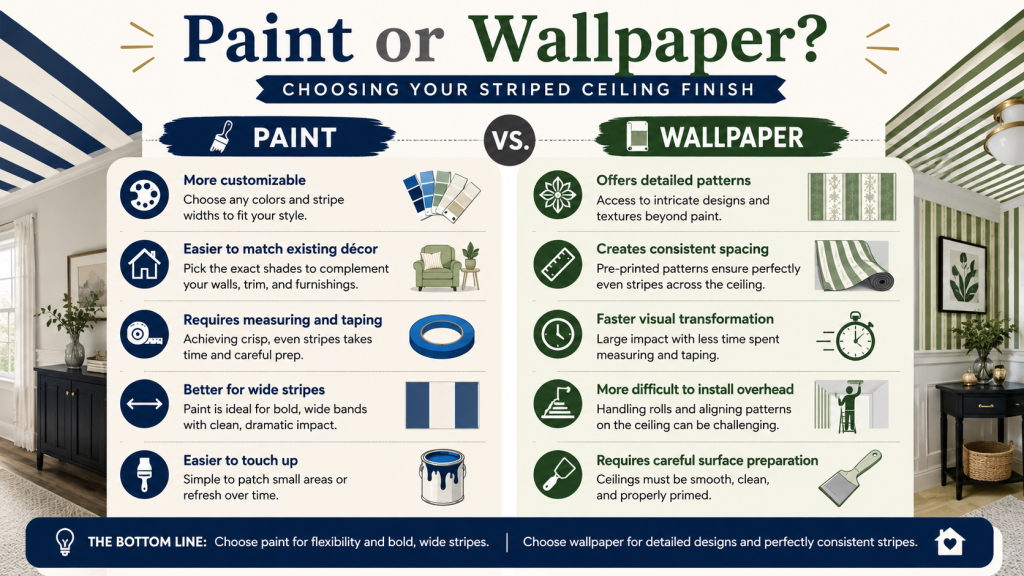
Wallpaper offers crisp repeat patterns, textured finishes, and combinations that would be tedious to paint. It is useful for fine ticking stripes, irregular hand-drawn bands, or subtle woven effects.
Gravity makes ceiling installation less forgiving. Choose a product approved for the surface, follow its adhesive instructions, and check whether wallcovering primer is required. Order samples because colors may look darker overhead. Test removable paper first; adhesion varies with finish, texture, humidity, and preparation.
Choose Colors That Belong in the Room
Start with something already present: upholstery, a rug, curtains, artwork, or cabinetry. Repeating one of those colors in the Striped Ceiling creates continuity. Then decide how much contrast you want.
Low contrast feels atmospheric; high contrast becomes the room’s headline. Check samples by day and night because warm bulbs can yellow creams, while cool light may flatten browns and pinks. Hold large sample boards overhead instead of judging small chips.
Measure the Layout Before Opening Paint
Measure in several places because older rooms are rarely square. Decide whether equal stripes, a centered feature stripe, or balanced edge bands matter most. Adjusted outer bands often beat one narrow leftover strip.
For parallel bands, divide the usable width by your chosen number of stripes. Mark both ends of every boundary, then connect them with a laser or chalk line. Label the sections receiving the second color with tape tabs. That simple step keeps the Striped Ceiling sequence clear while you work overhead.
How to Paint Crisp Ceiling Stripes
Remove dust, fill cracks, sand repairs, and paint the ceiling with the lighter base color. Let it dry as directed before taping.
Apply painter’s tape along the marked boundaries and press the edges firmly. For extra insurance, brush a thin coat of base color over each tape edge; any seepage will match the background. Once sealed, roll on the stripe color in light coats. Remove the tape while the final coat is slightly wet, pulling it back at an angle. Use a small angled brush for touch-ups after drying.
Work Around Fixtures, Beams, and Slopes
Treat fixed elements as part of the composition. Center a radial design on a pendant, stop bands neatly at beams, or cross a slope only when the transition stays consistent.
Turn off power before removing fixture covers, and hire a licensed electrician when wiring or mounting must change. Decorative lighting can reinforce the ceiling’s style; our guide to choosing antique chandeliers for timeless interiors helps compare scale, finish, and visual weight. Make sure the final pattern does not leave the fixture looking accidentally off-center.
Recommended Products for a Striped Ceiling
| Product | Best use |
| FrogTape Multi-Surface Painter’s Tape | Crisp painted edges |
| BOSCH GLL50-20 Cross-Line Laser | Layout alignment |
| Wooster SR090 Extension Pole | Standard ceilings |
| Purdy Clearcut Glide Brush | Edges and touch-ups |
| Warner 9-Inch Smoother | Wallcovering application |
| ROMAN PRO-880 Adhesive | Traditional wallpaper |
FrogTape Multi-Surface Painter’s Tape with PAINTBLOCK, 1 in Wide (0.94 in x 60 yd), 1 Roll
Best for: First-time stripe painters
This medium-adhesion tape is designed for cured painted surfaces and uses PaintBlock technology to help seal its edge. It is a practical starting point for a painted Striped Ceiling where clean boundaries matter. Test it on the existing finish first, and follow the package’s removal timing to reduce lifting.
BOSCH GLL50-20 50 Ft Self-Leveling Cross-Line Laser, Includes Integrated Magnetic Mount and 2 AA Batteries
Best for: Large rooms and precise layouts
This compact cross-line laser self-levels, flashes when outside its leveling range, and includes a magnetic mount. It creates long, repeatable guide lines without repeatedly moving a straightedge overhead. Its 50-foot working range suits many residential rooms, although you still need a suitable mounting surface or tripod position.
Wooster Brush SR090 Sherlock GT Convertible Extension Pole, 2–4 Feet
Best for: Reducing ladder movement
The SR090 extends from two to four feet, adding reach while rolling a standard-height ceiling. It pairs with compatible Wooster roller frames and can reduce repeated climbing. An extension pole improves reach, but it does not replace a stable ladder for taping, edging, fixture work, or close inspection.
Purdy 144152125 Clearcut Glide Angular Trim Paint Brush, 2-1/2 Inch
Best for: Detailed edges and corrections
This 2.5-inch angled brush uses nylon and polyester bristles and is shaped for trim and edging. It offers more control around ceiling perimeters, canopies, and small paint repairs than a full-size roller. Broad stripe sections will still go faster with a suitable roller.
Warner 9-Inch Flexible Plastic Smoother Spreader, 498
Best for: Peel-and-stick or pasted wallcoverings
Made from flexible polypropylene, this lightweight spreader is intended for smoothing wallcoverings and related materials. It can help move trapped air toward the edges while keeping pressure even. Delicate or textured papers may require a softer brush, so follow the wallcovering manufacturer’s directions.
ROMAN PRO-880 Wallpaper Adhesive, Ultra Clear Strippable
Best for: Traditional striped wallpaper
PRO-880 is a clear, strippable adhesive intended for many lightweight through heavyweight wallcoverings. It offers an option for non-prepasted striped paper when the manufacturer permits this adhesive type. Coverage and application vary, so confirm compatibility and use the recommended primer before installing overhead.
Research-Backed Guidance for Safer, Smarter Results
Visual-perception research supports treating stripe direction thoughtfully, but not making absolute room-size promises. A peer-reviewed 2004 study of the Helmholtz illusion found that line orientation changed how people judged the width of square figures. That finding helps explain the effect, but it does not prove one ceiling layout will make every room feel wider or taller.
The U.S. Environmental Protection Agency recommends increasing ventilation and following label precautions when using products that emit volatile organic compounds. Its guidance on VOCs and indoor air quality is especially relevant in bedrooms and other occupied spaces.
Before sanding or scraping a ceiling in a home built before 1978, review the EPA’s lead-safe renovation guidance for DIYers. The agency warns that renovation and painting work can create hazardous lead dust when lead-based paint is present.
Striped Ceiling FAQs
Do ceiling stripes make a room look bigger?
They can influence how your eye travels, but the result is not guaranteed. Direction, width, contrast, ceiling height, and furniture placement all matter. Broad, low-contrast bands often feel calmer. Test the layout with tape from the doorway and main seating position.
What stripe width works best on a ceiling?
Wide stripes are easier to read from floor level and require fewer taped boundaries. In many rooms, four to eight bands create a strong pattern without feeling frantic. Let the ceiling dimensions guide the width, center the layout, and avoid one awkwardly thin edge stripe.
Should a Striped Ceiling Be Flat or Eggshell?
Flat paint hides minor imperfections and limits glare, making it the safest default. Eggshell or satin can create deliberate sheen contrast, but reflective finishes highlight patches, roller marks, and uneven texture. When alternating sheens, test them overhead under the room’s actual lighting before covering the ceiling.
Can Peel-and-Stick Wallpaper Go on a Ceiling?
Sometimes, when the product and surface are suitable. Smooth, clean, cured paint is a better base than dusty, textured, damp, or chalky finishes. Test a sample for the recommended period. Traditional wallpaper with the specified primer and adhesive may be more dependable.
Is a Bold Striped Ceiling Suitable for a Small Room?
Yes. A powder room, closet, nursery, or entry can suit a dramatic ceiling because the limited area contains the pattern. Use fewer, broader bands or a framed border if full contrast feels overwhelming. Keep the walls and furnishings restrained so the Striped Ceiling has room to breathe.
Final Recommendation: Make the Striped Ceiling Feel Intentional
The best Striped Ceiling balances drama with the room’s architecture. Choose cabana stripes for a graphic statement, tone-on-tone bands for quiet sophistication, a sunburst for a centered showpiece, a painted border for controlled impact, or wallpaper for intricate pattern.
Before buying supplies, confirm the direction, test full-size colors overhead, inspect the surface, and plan around fixtures. FrogTape can simplify painted edges, while the BOSCH GLL50-20 establishes long guide lines. Repeat colors already present below so the bold choice feels considered and complete.